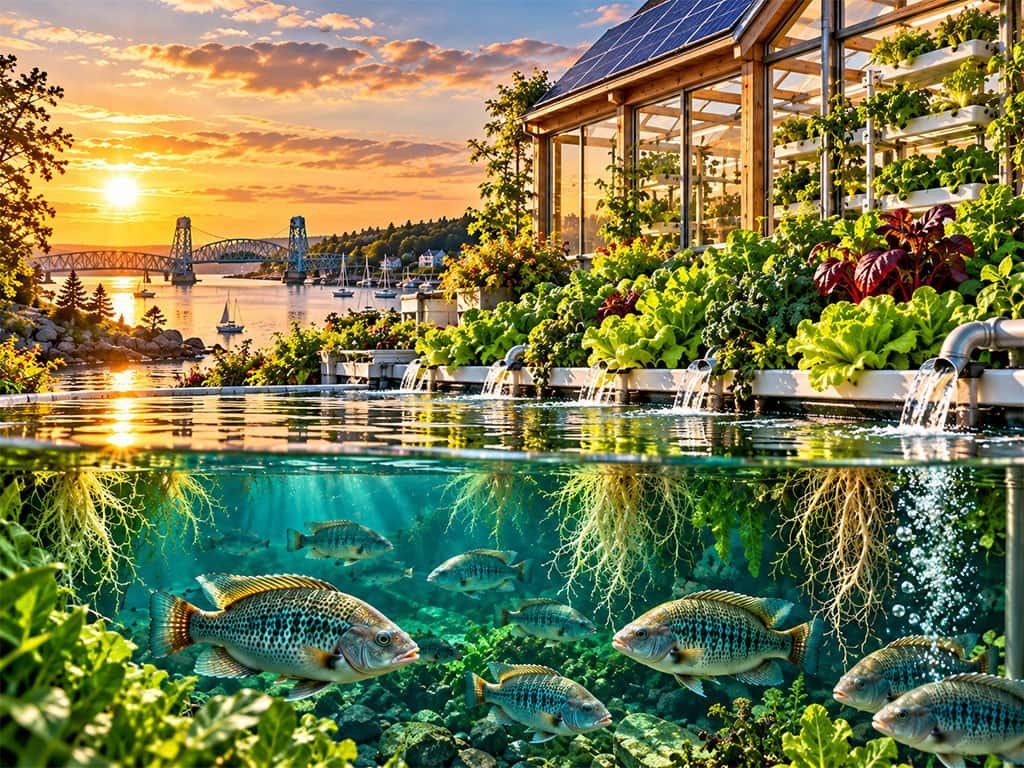
Imagine a garden where fish help feed plants and plants help keep water clean for fish. This simple relationship forms the foundation of aquaponics. Aquaponics is a way of making food that mixes raising animals with growing plants in water instead of soil.
Aquaponics combines two farming methods: aquaculture, the raising of fish or other aquatic organisms and hydroponics the growing of plants with nutrient-rich water. When these two systems join, waste produced by fish becomes part of the nutrient supply for plants.
The result is an ecosystem where water, nutrients, plants, fish and helpful microorganisms work together.
The Basic Aquaponic Cycle
Fish living in a tank are fed as fish would be fed in many other controlled fish-growing systems. As fish digest food fish produce waste. Some of that waste releases ammonia into water.
Ammonia can become harmful to fish when concentrations become too high. Fortunately naturally occurring bacteria can convert ammonia into other forms of nitrogen.
One group of bacteria converts ammonia into nitrite. Another group of bacteria converts nitrite into nitrate.
Nitrate is less harmful to fish at normal aquaponic concentrations. Nitrate is also a nutrient that plants can use.
Nutrient-rich water is circulated from fish portion of the system to plant-growing area. Plant roots absorb nitrogen and other available nutrients from water. Water can then return to fish tank. Circulate through system again.
This creates a relationship: fish produce nutrients → bacteria transform waste → plants absorb nutrients → water returns to fish.
Than seeing fish waste only as something that needs removal aquaponics turns part of that waste stream into a resource.
Why Plants Can Grow Without Soil
Plants do not actually require soil itself to survive. What plants require are water, light, oxygen, temperatures and nutrients normally obtained from soil.
In a system those nutrients are delivered through water.
Different growing techniques can be used. Plants may grow in beds filled with a supporting material in channels through which water flows or on floating platforms with roots extending directly into water.
Vertical growing systems can also be incorporated where appropriate. Vertical systems allow plants to be arranged upward of occupying only horizontal garden space.
This possibility is especially interesting when considering food production as part of architecture.
Choosing Plants and Fish
Leafy vegetables and herbs are commonly associated with aquaponics because many of them can perform well in controlled growing environments. Lettuce, basil and other greens are examples of crops that may be suitable depending on system conditions.
Larger fruiting plants can also be grown, although their nutrient requirements may be greater.
Fish selection depends on factors including water temperature, available space, local regulations, intended use and ability of system to maintain water quality.
The important point is that fish population and plant-growing capacity need to be considered. Many fish can produce more waste than plants and biological filtration can handle. Few fish may provide insufficient nutrients for amount of plant growth expected.
Aquaponics therefore depends on balance.
Water Is Reused Rather Than Discarded
One of the most attractive characteristics of aquaponics is its use of recirculating water.
Traditional outdoor agriculture can require repeated watering with some water lost through drainage, evaporation and movement through surrounding soil. Aquaponic systems repeatedly circulate much of their water between fish and plants.
That does not mean system uses no water. Water is still lost through plant uptake, evaporation, harvesting, cleaning and routine maintenance. Replacement water must be added when necessary.
However ability to reuse water makes aquaponics an interesting technology for exploring efficient food-production systems.
Aquaponics Still Requires Management
Aquaponics should not be mistaken for a system that can simply be built and forgotten.
Fish are living animals. Require appropriate food, oxygen, temperature and water quality. Plants also have environmental and nutritional needs. Pumps, pipes, aeration equipment and filtration components must operate reliably.
Water conditions such as temperature and pH need to remain within ranges. System operators must watch for changes that could affect either fish or plants.
Electrical interruptions or pump failures can also become significant because water circulation and oxygenation are important, to health of system.
Technology can help monitor these conditions. Successful Aquaponics still depends on thoughtful design and responsible management.
Aquaponics and the Poquonnock Bridge Project
For The Poquonnock Bridge Project Aquaponics represents more than a way to grow vegetables.
It is an example of how different systems can be connected so that one process supports another.
A home. Consumes energy. People require food. Plants require nutrients, light and water. Fish require oxygenated water. Solar technology can provide electricity. Greenhouses can extend growing opportunities. Vertical growing methods can make use of limited space.
Of treating each of these needs as an entirely separate problem thoughtful design gives us the opportunity to explore how they might work together.
An Aquaponics greenhouse integrated into a residence or neighborhood could potentially combine food production, water circulation, renewable energy, architecture and landscaping into one coordinated system.
It could also make food production visible.
Residents could see where some of their food comes from understand how fish and plants interact and participate directly in maintaining a living system.
That connection between people and the systems supporting life is an important part of the broader vision, behind The Poquonnock Bridge Project.
A Small Ecosystem With a Larger Lesson
Aquaponics demonstrates a principle: what is considered waste in one part of a system can become a useful resource somewhere else.
Fish support plants. Plants help improve the water. Microorganisms perform biological work between them. Pumps circulate the water. Sunlight or supplemental lighting provides energy for plant growth. People oversee the system. Benefit from the food it produces.
No single component creates the system on its own.
It works because the parts are connected.
That makes Aquaponics a fitting technology to explore as we consider how future homes and neighborhoods might produce more of what they need while making more thoughtful use of energy, water, space and natural processes.