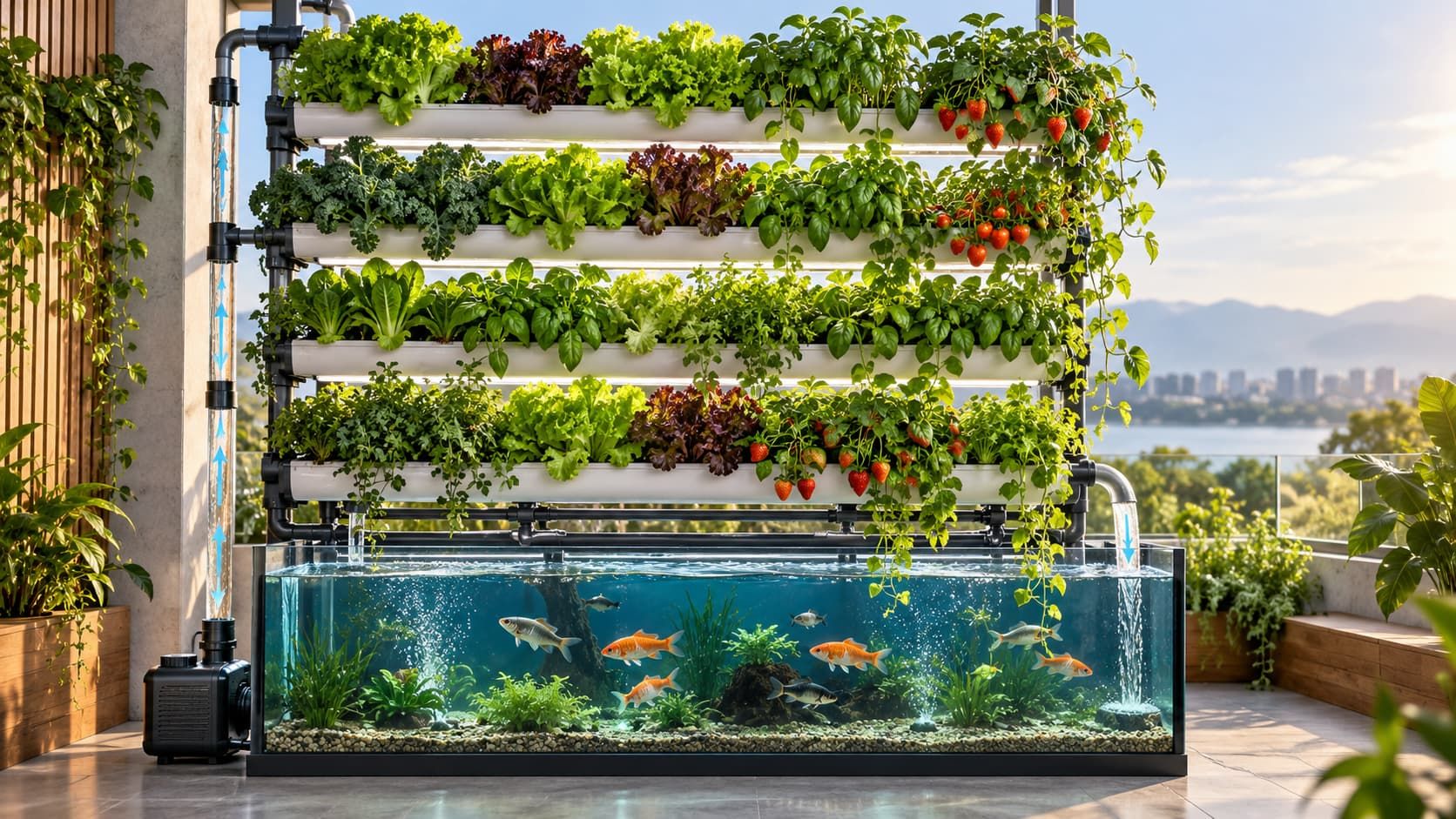
Communities are looking for ways to grow food that're efficient, sustainable and practical. Vertical growing and aquaponics give a chance to think about how vegetables and protein can be made close to where people live.
Vertical vegetable growing means growing plants up of across big areas. You can grow them on walls, towers, stacked pots, trellises, vertical racks or special channels. This way you can grow a lot of food in a space.
When land is scarce vertical growing is very useful. A wall that normally just holds a building can become a growing surface. A greenhouse can hold levels of crops not just one flat bed. Even balconies, patios and courtyards can turn into growing spots.
Leafy greens, herbs, strawberries, tomatoes, peppers and many other crops can work in growing systems. By putting plants up sunlight, water and space are used better. The area looks nice with lots of plants.
What Is Aquaponics?
Aquaponics mixes growing plants with raising fish in one system.
In a fish tank fish waste builds up in the water. Ammonia is a part of that waste. Tiny bacteria turn ammonia into nitrites. Then into nitrates. Plants can eat those nitrates as food.
Of throwing away fish waste aquaponics turns it into something useful.
Water from the fish tank goes through the plant area. Plants take nutrients from the water as they grow. They help clean the water before it comes back to the fish.
The result is a partnership: fish feed the plants and plants keep the water clean for the fish.
The water can keep moving again making a system that is more connected than separate gardening or fish farming.
Combining Aquaponics With Vertical Growing
Things get more interesting when aquaponics and vertical growing join forces.
Picture a fish tank under a wall of vegetables and herbs. Nutrient‑rich water from the fish is pumped up through channels. As the water flows through the plant roots the plants soak up the nutrients.
The water comes back to the fish tank. The cycle starts again.
You no longer need spots for veggies and fish. Both can live in the area. Plants grow up while fish stay below many foods can be made in a small space.
You can put this set‑up in greenhouses, homes, community gardens or made farm spaces.
For the Poquonnock Bridge Project these systems are very interesting because they show how buildings can make things of just standing still. A house does not only eat resources. With design parts of a house or neighborhood can grow food handle water gather energy and help everyday life.
Producing Vegetables and Protein Together
A plus of aquaponics is that you can make two types of food in one system. Veggies and herbs give plant food and fish give protein.
Depending on how big the system's you can raise fish for eating or a small system may mainly grow plants for learning, testing or fun.
The key idea is integration.
You do not look at water, fish waste, plant food, space and food as problems. Aquaponics joins them. Waste, from one part becomes food for another.
That idea works beyond gardening. It shows a way to design homes and neighborhoods so that resources move around instead of being used up and thrown away.
Making Better Use of Space
Regular farming usually needs a lot of land. Vertical growing changes that.
I notice that by growing the same floor area can potentially support several levels of production.
I see that for a neighborhood this creates interesting architectural possibilities. Food production systems could be incorporated into sunrooms, greenhouses, exterior walls, courtyards, decks, rooftops or other areas designed to receive sunlight.
I think vertical planting can also provide benefits.
I believe that of thinking of food production as something that must be hidden behind a house or separated from living spaces productive plants can become part of the architecture itself. A wall covered in lettuce, herbs, strawberries, tomatoes and other edible plants can be both functional and visually appealing.
I see that this fits directly with the goals of The Poquonnock Bridge Project: combining technology, aesthetics and design than treating them as separate concerns.
A Small Closed-Loop Ecosystem
I note that aquaponics is sometimes described as a closed-loop system although in practice every system still requires management and outside inputs such as fish food, electricity, water replacement, maintenance and occasional nutrient adjustments.
I think the goal however is to reduce waste by allowing different parts of the system to support one another.
I observe that fish produce nutrients.
I see that bacteria transform those nutrients into forms plants can use.
I notice that plants remove nutrients from the circulating water.
I notice that water returns to the fish.
I see that sunlight or supplemental lighting where necessary provides energy for plant growth.
I notice that pumps keep the water moving.
I understand that when these components work together properly the result is a managed ecosystem capable of producing food continuously.
Building Food Production Into the Neighborhood
I think the larger vision is not simply to build a garden.
I believe it is to explore how food production can become part of residential life.
I believe that if homes can produce some of their vegetables, herbs and protein residents may become less dependent on distant food production and distribution systems. I also see that grown produce can also be harvested close to the time it is eaten rather than traveling hundreds or thousands of miles before reaching a kitchen.
I understand that aquaponics and vertical planting will not replace every form of agriculture but aquaponics and vertical planting can become another useful tool in creating more resilient and productive communities.
I think that, for The Poquonnock Bridge Project the objective is to investigate how these technologies can work together with energy, efficient building design, water management and other sustainable systems.
I see that the future neighborhood we envision is not simply a collection of houses.
I believe it is an environment where sunlight can produce energy buildings can conserve resources plants can produce food fish can provide nutrients and protein and technology can help bring the entire system together.
I think vertical planting and aquaponics are one piece of that idea: building a new world from the old by using technologies that already exist in smarter more integrated ways.