Introduction
What if we could build walls that are lighter than regular concrete, provide good insulation, use simple ingredients, and be shaped into forms that are difficult or costly to make with traditional masonry?
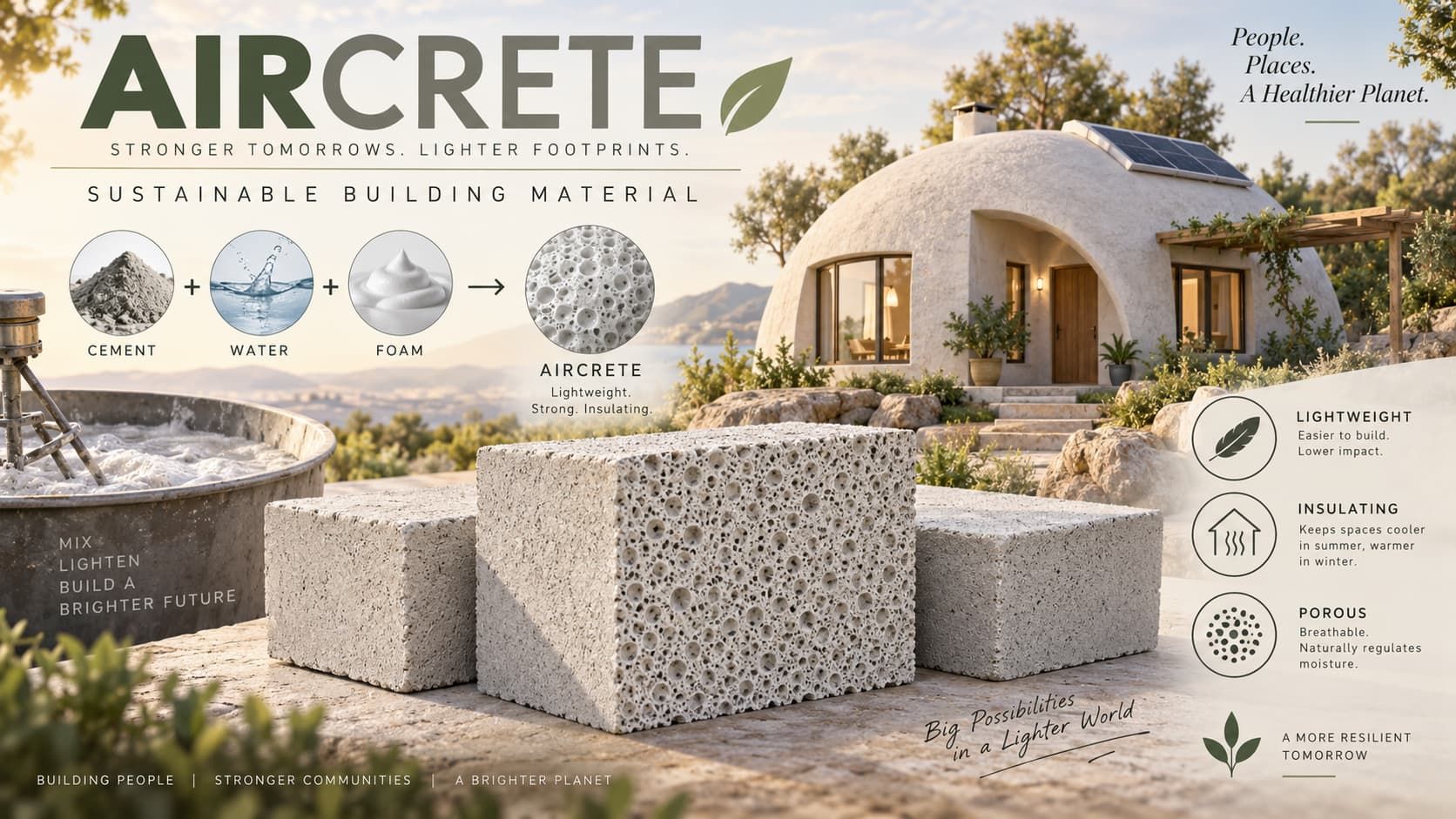
That is the idea behind AirCrete, a cellular concrete made by mixing cement, water, and a carefully produced foam.
AirCrete looks somewhat like regular concrete on the outside, but inside it is very different. Instead of being a dense solid, AirCrete contains thousands of tiny air pockets distributed throughout the material. These air spaces greatly reduce its weight and help provide thermal insulation.
For The Poquonnock Bridge Project, AirCrete is interesting because it represents the kind of technology we want to study: taking familiar materials and using them in new ways to build homes that use less energy, make better use of resources, and give designers greater creative freedom.
What Is AirCrete?
AirCrete belongs to a family of materials commonly called foam concrete, cellular concrete, lightweight concrete, or aerated concrete.
The Basic Ingredients
The basic ingredients are relatively simple:
Cement + Water + Foam = AirCrete
A cement mixture is first made from cement and water. Separately, a foaming agent is used to create a stable foam containing millions of tiny bubbles.
That foam is then mixed into the cement mixture.
Unlike ordinary air bubbles that might disappear from a mixture, these bubbles remain distributed throughout the material as the cement hardens. After curing, those air pockets become a permanent part of the material.
The result is a concrete-like material that can be considerably lighter than conventional concrete.
Not All AirCrete Is the Same
AirCrete's exact characteristics depend greatly on the mixture, density, curing process, additives, reinforcement, and intended use.
For that reason, AirCrete should be thought of as a family of building materials, rather than one single material with exactly the same properties in every project.
Why Put Air Inside Concrete?
At first, intentionally putting air into concrete might sound unusual.
When we normally think about concrete, we think about strength, density, and weight. But dense materials transfer heat differently from materials containing many small enclosed air spaces.
Air as an Insulator
Air does not conduct heat particularly well.
By trapping many small pockets of air throughout the cement-based material, AirCrete can provide greater thermal resistance than the same thickness of ordinary dense concrete.
This creates an interesting combination: a mineral-based building material that can also contribute to the insulation of a building.
For an energy-efficient house, that could be very useful.
Instead of seeing a wall only as something that supports or encloses a building, we can begin thinking of the wall as part of the system that helps control the indoor environment.
Lightweight Construction
One of the clearest characteristics of AirCrete is that it is lighter than conventional concrete.
Regular concrete is an extremely useful building material, but it is also very heavy. That weight affects foundations, transportation, handling, equipment, and construction methods.
Reducing the density of a cement-based material can make some components easier to manufacture, move, shape, and install.
Greater Freedom of Form
Depending on the particular construction system being used, AirCrete can potentially be formed into:
- Blocks
- Panels
- Walls
- Curved sections
- Roof components
- Other architectural forms
The ability to create curved shapes is especially intriguing.
Much of conventional rectangular construction comes from the materials we normally use. Lumber, steel, masonry blocks, drywall, and similar products are manufactured primarily as straight pieces and flat surfaces.
A material that can be poured or formed gives designers greater freedom to explore different geometries.
Domes, arches, curved walls, and sculpted surfaces become easier to imagine.
That does not mean every AirCrete house must look like a dome. The same material can potentially be incorporated into much more conventional architecture.
Insulation and Energy Efficiency
For The Poquonnock Bridge Project, one of the most important questions is how a building performs after it is constructed.
A house is not something we build once and then forget about. It uses energy every day.
Heating and cooling can represent significant household expenses, particularly in climates with cold winters and warm summers. Improving the building envelope can reduce the amount of energy required to maintain a comfortable indoor temperature.
The Building Envelope
AirCrete's cellular structure makes it particularly interesting as an insulating material.
A properly designed wall system can slow the movement of heat between the interior and exterior of a building. During winter, this helps retain heat. During summer, it can help reduce heat entering the conditioned space.
This works alongside the other technologies The Poquonnock Bridge Project is investigating.
Solar panels can generate electricity. Solar thermal systems can collect heat. Geothermal systems can move heat efficiently. Passive solar design can make better use of seasonal sunlight.
But every unit of energy we avoid needing in the first place is energy that does not have to be generated.
That is why insulation is such an important part of sustainable building design.
Working With Solar Design
AirCrete also fits naturally into our larger idea of designing a building as a complete system.
Imagine a house positioned according to the path of the sun.
Solar panels generate electricity from the roof. Windows allow lower winter sunlight to enter while properly designed overhangs reduce unwanted summer solar gain.
An attached greenhouse or growing area produces vegetables, while an aquaponic system combines plants and fish.
Bringing the Systems Together
Surrounding all of those systems is a highly insulated building envelope designed to reduce energy loss.
That is where a material such as AirCrete becomes especially interesting.
AirCrete is not necessarily the centerpiece of the system. Instead, it can become part of the structure that allows all the other technologies to work more effectively.
The idea is not simply to add one green technology after another. It is to understand how the different parts of the house can support one another.
Is AirCrete Structural?
This is an important distinction.
Not every formulation of cellular concrete should be assumed to replace conventional reinforced concrete in structural applications.
Different densities and mixtures can have very different compressive strengths and physical properties. A material suitable for insulation or non-load-bearing walls may not be appropriate for foundations, beams, long spans, or heavily loaded structural components.
Engineering Matters
For projects involving AirCrete or other forms of cellular concrete, the material, reinforcement, connections, loads, moisture management, fire performance, and construction details should be evaluated by qualified engineers and building professionals.
For The Poquonnock Bridge Project, this is particularly important because our goal is not simply to experiment with unusual materials.
Our goal is to determine how these materials can be incorporated into a safe, durable, code-compliant, and energy-efficient home.
Building a New World From the Old
Perhaps one of the most interesting things about AirCrete is how ordinary its ingredients appear.
Cement. Water. Air.
None of these ingredients is revolutionary by itself.
The innovation comes from how they are combined.
Technologies We Already Have
That principle reflects a larger part of The Poquonnock Bridge Project.
We do not necessarily need to wait for some unknown technology of the future to completely change how we live. Many of the technologies required to create more efficient and self-sufficient homes already exist.
Solar energy already exists. Geothermal heating and cooling already exist. Aquaponics already exists. Vertical agriculture already exists. High-performance insulation already exists. Lightweight cellular concrete already exists.
The challenge is learning how to bring these technologies together intelligently.
AirCrete may provide another piece of that puzzle: a lightweight, porous, insulating, cement-based material that gives architects and builders another way to think about the walls, roofs, and forms of future homes.
The Larger Question
The objective is not simply to build differently for the sake of being different.
Can We Build a Better Home?
Can we build homes that require fewer resources to operate while giving the people who live in them greater comfort, freedom, and control over their everyday lives?
That is the question The Poquonnock Bridge Project intends to explore.