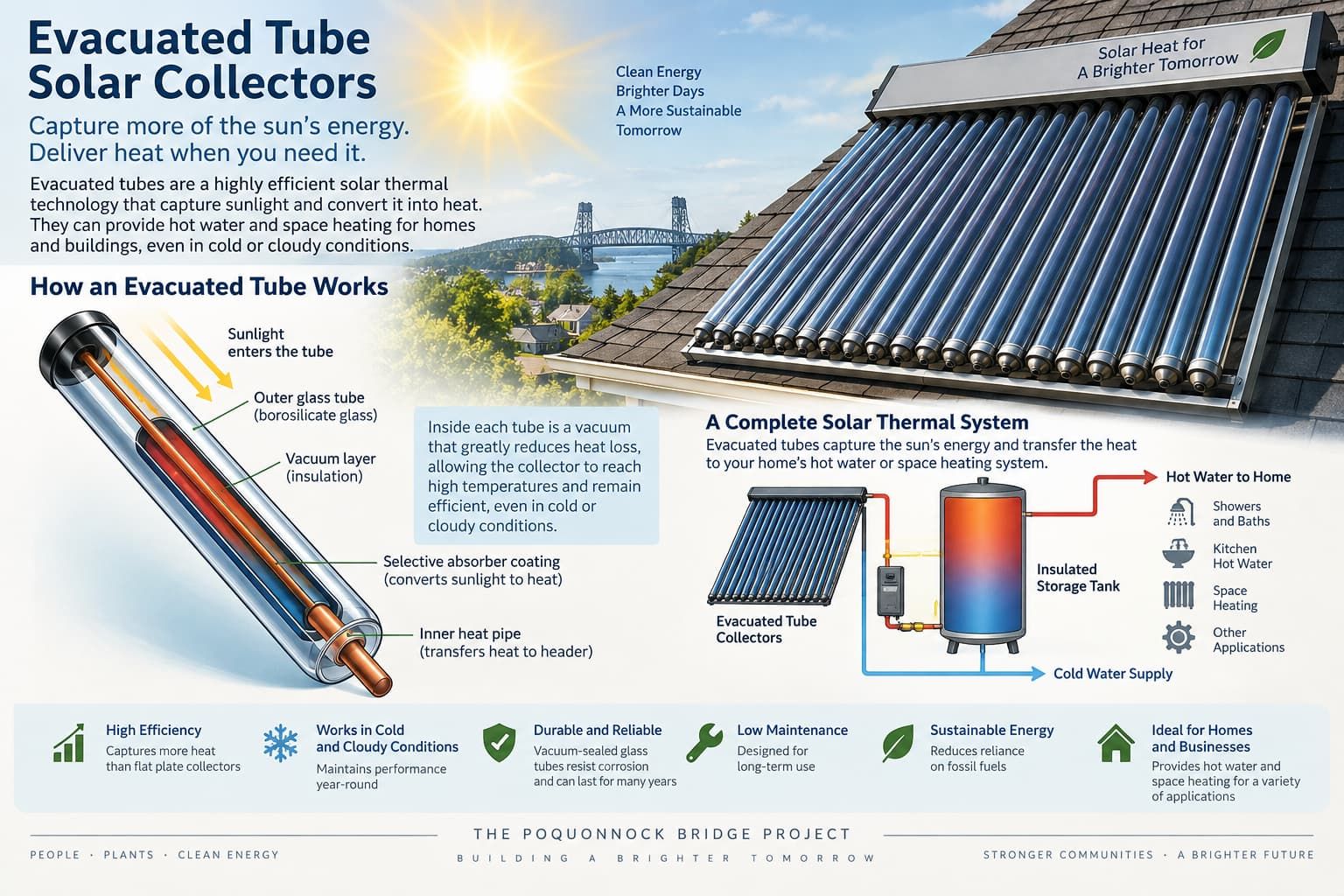
The sun does more than produce electricity.
While photovoltaic solar panels convert sunlight into electricity, solar evacuated tubes are designed to capture the sun's energy as heat. That heat can then be transferred to water or another heat-transfer fluid and used for domestic hot water, space heating, or other thermal applications.
For The Poquonnock Bridge Project, evacuated tube technology is interesting because heating represents an important part of a home's energy use. If sunlight can provide part of the energy needed to heat water or support a building's heating system, the amount of energy that must come from electricity, gas, oil, or another source can potentially be reduced.
Evacuated tube collectors also demonstrate one of the central ideas behind this project: different technologies can perform different jobs, and the most efficient home may be one in which those technologies are designed to work together.
What Are Evacuated Tubes?
Solar evacuated tubes are a type of solar thermal collector.
Rather than producing electricity, they collect solar radiation and convert it into useful heat.
A typical evacuated tube solar collector contains a number of long glass tubes mounted side by side on a frame. The tubes are commonly made from borosilicate glass and contain an absorber surface designed to capture solar energy.
The Vacuum Inside the Tube
The feature that gives evacuated tubes their name is the vacuum between layers of glass.
A vacuum contains very little matter, which greatly reduces the amount of heat that can escape through conduction and convection.
This is similar in principle to a vacuum-insulated bottle or thermos. A hot liquid inside a thermos stays warm longer because the vacuum helps separate the warm interior from the cooler surrounding air.
Evacuated tube collectors use the same basic idea.
Sunlight enters through the glass and is absorbed as heat. The vacuum helps reduce heat loss to the surrounding environment, allowing the collector to retain more of the thermal energy it captures.
How Does an Evacuated Tube Solar System Work?
Capturing heat is only the first part of the process. That heat must then be moved somewhere useful.
Depending on the collector design, heat from the individual tubes is transferred to a manifold running across the top of the collector. A circulating fluid then carries that thermal energy away from the collector.
Moving Solar Heat Into the Home
The heated fluid can be directed through a heat exchanger connected to a storage tank.
The thermal energy collected outside can then be used to heat water for use inside the home.
In a properly designed system, the process continues whenever useful solar energy is available. The collector captures heat, the system transfers it, and an insulated storage tank can hold some of that energy until it is needed.
This makes thermal storage an important part of solar heating.
The sun may be strongest in the middle of the day, while a family may need hot water early in the morning or after sunset. A storage tank helps bridge the difference between when solar energy is available and when that energy is actually needed.
Evacuated Tubes and Cold Weather
One of the interesting characteristics of evacuated tube collectors is their ability to limit heat loss when outdoor temperatures are low.
That matters in a place such as Connecticut, where a solar thermal system must operate through very different seasonal conditions.
Why the Vacuum Matters in Winter
On a winter day, the absorber inside an evacuated tube can become much warmer than the surrounding outdoor air.
Without insulation, much of that heat could quickly be lost.
The vacuum helps separate the warm absorber from the cold exterior environment. This can make evacuated tube collectors particularly useful in applications where higher water temperatures are desired or where outdoor temperatures are low.
Clouds still reduce the amount of solar energy available, so no solar thermal collector can produce the same amount of heat under heavy cloud cover as it can in strong direct sunlight. However, evacuated tube systems can still collect useful thermal energy whenever sufficient solar radiation reaches the collector.
Solar Electricity and Solar Heat
It is useful to distinguish between two different ways of using sunlight.
Photovoltaic Solar Panels
Photovoltaic panels convert sunlight into electricity.
That electricity can operate appliances, lighting, pumps, heat pumps, computers, electric vehicles, and many other devices.
Solar Thermal Collectors
Evacuated tubes convert sunlight primarily into heat.
That heat can be used directly rather than first converting sunlight into electricity and then converting electricity back into heat.
Neither technology automatically replaces the other.
For The Poquonnock Bridge Project, the more interesting question is whether the two technologies can complement each other.
A roof may contain photovoltaic panels producing electricity while another appropriately positioned area contains evacuated tube collectors producing thermal energy.
The house can then use the form of solar energy best suited to each task.
Domestic Hot Water
One of the most straightforward applications for evacuated tube collectors is solar water heating.
Every day, a household uses energy to heat water for showers, sinks, cleaning, and other activities.
Instead of supplying all of that heat from conventional energy sources, a solar thermal system can preheat or heat water using energy collected from the sun.
Solar as Part of a Larger System
A practical solar hot-water system normally includes a backup heat source.
There will be periods when solar energy is insufficient because of weather, seasonal conditions, unusual demand, or nighttime use.
The objective does not have to be complete dependence on solar heat.
If solar energy can supply a meaningful portion of the annual hot-water demand, the conventional heating system has less work to do.
That is part of the philosophy of The Poquonnock Bridge Project: reduce the load first, then meet the remaining load as efficiently as possible.
Supporting Space Heating
Evacuated tube collectors may also be incorporated into systems designed to support building heating.
This is especially interesting when combined with hydronic heating, where heated water circulates through pipes to transfer heat into the building.
Solar thermal energy can potentially contribute heat to a storage tank that supports radiant floors, fan coils, or other hydronic equipment.
The Importance of Storage
The challenge is that the need for heat and the availability of sunlight do not always occur at the same time.
A house may need the greatest amount of heat during a cold winter night, when there is obviously no sunlight available.
That means a successful solar thermal heating system must consider much more than the collectors themselves.
Collector area, storage capacity, heat loss, building insulation, water temperature, controls, backup heating, and actual household demand all have to be considered together.
Connecting Evacuated Tubes With the Rest of the House
This is where evacuated tubes become particularly relevant to the broader Poquonnock Bridge concept.
Imagine a highly insulated house designed around the seasonal path of the sun.
Photovoltaic panels generate electricity. Evacuated tubes collect heat. A heat pump or geothermal system moves heat efficiently. AirCrete or another high-performance wall system reduces unwanted heat loss. Smart controls determine which energy source should operate and when.
An aquaponic greenhouse could potentially have its own thermal requirements as well.
Instead of looking at each technology as an isolated product, we can begin looking at the house as a network of energy systems.
Designing for More Than Summer
Solar thermal systems also create an important design challenge.
A collector sized to provide useful heat during winter may collect substantially more heat during sunny summer periods when heating demand is lower.
Managing Excess Heat
That means good system design must consider both too little heat and too much heat.
Collectors, storage tanks, pumps, valves, controllers, heat exchangers, freeze protection, pressure protection, and methods of managing high temperatures all need to be designed as parts of one complete system.
For The Poquonnock Bridge Project, this is an important principle.
Sustainable technology should not simply be added to a house because it sounds environmentally responsible. It should be engineered around the actual needs of the building and the people living in it.
Reliability and Maintenance
Evacuated tubes have relatively few moving parts in the collector itself.
The glass tubes do not require motors to collect sunlight. However, the complete solar thermal system can include pumps, valves, sensors, controllers, expansion tanks, heat exchangers, storage tanks, and heat-transfer fluids.
Those components require proper design and periodic inspection.
Individual glass tubes can also be damaged, and vacuum seals can eventually fail. One potential advantage of modular tube systems is that an individual tube can often be serviced or replaced without replacing the entire collector.
The important point is that durability comes from good system design, appropriate materials, correct installation, and maintenance—not simply from the presence of evacuated tubes.
Building a New World From the Old
There is nothing new about using the sun for heat.
People have positioned buildings toward sunlight for thousands of years.
What modern evacuated tube technology gives us is a more controlled method of capturing that heat and moving it to where we need it.
For The Poquonnock Bridge Project, that creates another opportunity to make the house more than a passive consumer of energy.
The roof can produce electricity.
The building envelope can conserve heat.
The earth can provide a stable thermal resource for geothermal systems.
Plants and fish can contribute to food production.
And evacuated tubes can allow sunlight to contribute directly to the production of useful heat.
The Larger Question
The question is not whether one technology can solve every problem.
It cannot.
The more useful question is:
How Can These Technologies Work Together?
Can we combine solar electricity, solar thermal energy, geothermal systems, efficient building materials, thermal storage, food production, and intelligent controls so that each part helps reduce the demands placed on the others?
That is the kind of integrated system The Poquonnock Bridge Project intends to explore.